Christ the King: The King Who Reigns Through Love and Service
Dear brothers and sisters in Christ,
Today, the Church celebrates the Solemnity of Our Lord Jesus Christ, King of the Universe. This celebration brings the liturgical year to a close and reminds us that Jesus Christ is the King of all creation. His kingdom has no end, and His authority is greater than every earthly power.
However, when we hear the word "king", we often think of someone who sits on a throne, commands people, possesses great wealth, and exercises authority over others. But Jesus presents us with a different understanding of kingship.
In today's Gospel, Jesus describes Himself as a King who identifies with the hungry, the thirsty, the stranger, the naked, the sick, and those in prison. He teaches that whatever we do for the least of our brothers and sisters, we do for Him.
The first reading from the prophet Ezekiel presents God as a shepherd who personally cares for His sheep, seeking the lost, bringing back the strayed, healing the injured, and strengthening the weak. The second reading from St. Paul's First Letter to the Corinthians reminds us that Christ has conquered death and will ultimately bring everything under His authority.
Together, these readings teach us that Christ is a King who loves, cares, saves, and judges with justice. They also remind us that if we belong to His kingdom, our lives must reflect His love and compassion.
1. Christ Is a King Who Cares for His People
In the first reading, God speaks through the prophet Ezekiel, saying:
“I myself will look after and tend my sheep.” (Ezekiel 34:11)
God presents Himself as a shepherd who personally takes responsibility for His flock. He does not abandon His people or leave them to suffer without care.
He promises:
“The lost I will seek out, the strayed I will bring back, the injured I will bind up, the sick I will heal.” (Ezekiel 34:16)
This is the kind of King we celebrate today. He is not a distant ruler who is unconcerned about the struggles of His people. He knows their needs, sees their suffering, and comes to their assistance.
Earthly rulers may sometimes forget the people they are supposed to serve. They may become more concerned about their positions, privileges, and personal interests than the welfare of those under their authority.
But Christ is different. His kingship is demonstrated through care, compassion, and service.
He seeks those who are lost, restores those who have gone astray, and strengthens those who are weak.
This should give us hope because none of us is beyond His concern. Even when we have made mistakes, wandered away from God, or become spiritually weak, Christ continues to call us back to Himself.
We should therefore never think that our struggles are hidden from Him or that He has abandoned us.
2. Christ Is Not Only Our King; He Is Our Shepherd
The Responsorial Psalm reminds us:
“The Lord is my shepherd; there is nothing I shall want.” (Psalm 23:1)
A shepherd guides, protects, feeds, and watches over the sheep. He does not simply give instructions from a distance; he remains close to the flock.
The image of the shepherd in the first reading and the psalm helps us understand the kingship of Christ.
Jesus does not reign by terror or oppression. He leads His people towards life. He guides us when we are confused, strengthens us when we are weak, and gives us rest when we are weary.
The psalm also says that even when we walk through the darkest valley, we need not fear because the Lord is with us.
This is an important message for us today. We all experience difficult moments. Some struggle with financial difficulties, some with family problems, some with sickness, and others with disappointment and uncertainty about the future.
But the celebration of Christ the King reminds us that we are not alone. We have a Shepherd who walks with us.
The question is whether we are willing to follow His voice.
If Christ is truly our King, we must allow Him to guide our decisions, direct our actions, and lead us along the right path.
3. Christ's Kingdom Is Greater Than Every Earthly Power
The second reading from St. Paul's First Letter to the Corinthians reminds us that Christ has been raised from the dead.
St. Paul writes:
“For just as in Adam all die, so too in Christ shall all be brought to life.” (1 Corinthians 15:22)
He explains that Christ is the firstfruits of those who have died and that He must reign until every enemy has been placed under His feet.
The last enemy to be destroyed is death.
This is the foundation of our Christian hope. Christ's kingship is not limited to earthly affairs or temporary authority. His victory extends even over death.
Every earthly kingdom eventually comes to an end. Political leaders leave office, powerful people grow old, wealth disappears, and human achievements eventually fade.
But the kingdom of Christ is eternal.
His resurrection has opened the way to eternal life, and His reign will bring all things under the authority of God.
Therefore, we must not allow temporary earthly things to become more important than our relationship with Christ.
Our positions, possessions, and achievements have value only within the time God has given us. What matters ultimately is whether we belong to Christ and remain faithful to Him.
4. The King Will Come to Judge All People
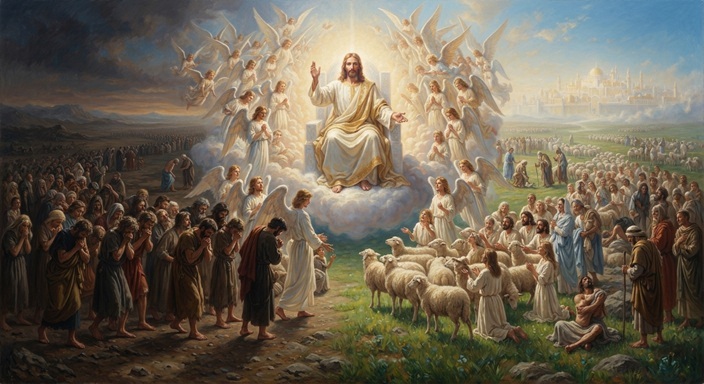
In the Gospel, Jesus describes the Son of Man coming in glory with His angels and sitting on His glorious throne.
All the nations will be gathered before Him, and He will separate people as a shepherd separates sheep from goats.
This is a powerful image of the final judgment.
It reminds us that Christ is not only a loving Shepherd; He is also the righteous Judge.
The first reading already prepares us for this when God says that He will judge between one sheep and another.
The Gospel shows us that every person will eventually stand before Christ. Our lives, decisions, and actions matter, and we will be accountable for how we have lived.
Sometimes, people behave as though they will never have to give an account to anyone. They exploit others, act unjustly, and pursue their own interests without considering the consequences.
But today's Gospel reminds us that earthly power and human approval cannot determine our final destiny.
One day, the King will judge us according to the way we have lived.
This should not make us live in constant fear. Rather, it should encourage us to examine our lives, repent where necessary, and take our Christian responsibilities seriously.
5. The King Identifies Himself with the Poor and Needy
One of the most remarkable parts of today's Gospel is that Jesus identifies Himself with people who are suffering.
He says:
“For I was hungry and you gave me food, I was thirsty and you gave me drink, a stranger and you welcomed me.” (Matthew 25:35)
He also mentions those who are naked, sick, and imprisoned.
What is striking is that Jesus does not say that these people merely deserve our sympathy. He identifies Himself with them.
This means that when we encounter someone who is hungry, neglected, sick, or in need of help, we are encountering someone with whom Christ has identified Himself.
We often look for God in beautiful churches, religious celebrations, and moments of prayer. These are important, but today's Gospel challenges us to recognise that Christ also meets us in the suffering of our brothers and sisters.
He is present in the poor person who needs food, the sick person who needs attention, the stranger who needs welcome, and the lonely person who needs someone to care.
We cannot claim to honour Christ as King while deliberately ignoring those whom He has placed before us in need.
If we want to serve Christ, we must also be willing to serve those who are suffering.
6. Love Must Be Practical, Not Merely Words
In today's Gospel, Jesus does not ask the people whether they attended many religious gatherings, how many prayers they recited, or how many times they publicly professed their faith.
Instead, He speaks about feeding the hungry, giving drink to the thirsty, welcoming strangers, clothing the naked, and visiting the sick and imprisoned.
This teaches us that genuine Christian love must be demonstrated through practical actions.
It is possible to speak beautifully about love while refusing to help someone in need. We may pray for the poor but never make any effort to assist them. We may talk about compassion but treat people harshly when they inconvenience us.
The Gospel challenges us to move beyond words.
If someone is hungry and we have the means to help, we should help. If someone is sick and needs encouragement or assistance, we should not ignore them. If a stranger needs welcome, we should not treat that person with contempt.
Even small acts of kindness matter.
A visit to someone who is sick, a meal offered to someone who is hungry, a kind word spoken to someone who is discouraged, or assistance given to a person in difficulty can become an expression of our love for Christ.
The King is asking us to recognise Him in the people around us.
7. We Must Not Become Indifferent to the Suffering of Others
In the Gospel, those who are placed on the left are condemned because they failed to respond to the needs of others.
They did not necessarily say that they hated Jesus. Their failure was that they ignored Him when He appeared in the form of people who needed their help.
This is a serious warning against indifference.
Sometimes, the greatest obstacle to Christian love is not open hatred but the decision not to care.
We see people suffering and convince ourselves that their problems have nothing to do with us. We see someone in need and assume that another person will help. We notice injustice but remain silent because speaking up may inconvenience us.
Gradually, we become comfortable with the suffering of others.
Today's Gospel challenges this attitude.
We cannot live as though the problems of our neighbours are completely separate from our Christian responsibilities.
In our families, communities, workplaces, and parishes, there are people who need our attention and support.
Sometimes, what they need is not even money. They may need someone to listen, someone to visit, someone to encourage them, or someone who will treat them with dignity.
Let us not allow selfishness and indifference to make us blind to the needs around us.
8. Our Final Reward Depends on Our Faithful Response to Christ
At the end of the Gospel, the King invites those on His right:
“Come, you who are blessed by my Father. Inherit the kingdom prepared for you from the foundation of the world.” (Matthew 25:34)
This is the promise of eternal life.
The people who receive this invitation are those whose lives demonstrated love through their actions.
They may not have recognised that they were serving Christ when they helped the hungry, welcomed the stranger, or visited the sick. Yet the King reveals that their actions were done for Him.
This teaches us that we do not always need extraordinary opportunities to serve God. The ordinary situations of daily life provide us with opportunities to demonstrate our love.
We can serve Christ in our homes by caring for our families. We can serve Him in our workplaces by treating people fairly. We can serve Him in our communities by helping those who are struggling.
Every day presents us with opportunities to choose compassion over indifference, generosity over selfishness, and service over pride.
At the same time, we must remember that our good works are not a way of purchasing God's love. They are the fruit of a life that has received His love and allowed it to transform the heart.
The question is whether our lives reflect the love of the King we profess to follow.
Conclusion: Let Christ Reign in Our Hearts
Dear brothers and sisters in Christ, today we celebrate Jesus Christ as King of the Universe.
The first reading presents Him as the Shepherd who seeks the lost, heals the injured, and strengthens the weak. The Responsorial Psalm reminds us that the Lord is our Shepherd. The second reading proclaims His victory over death and His eternal reign. The Gospel reveals that He is the King who identifies Himself with the poor, the hungry, the sick, the stranger, and those in prison.
As we bring this liturgical year to a close, we must ask ourselves some important questions:
- Does Christ truly reign in my heart, or have I allowed worldly desires to control my life?
- Do I recognise Christ in the poor, the sick, and those who need my assistance?
- Have I been indifferent to the suffering of people around me?
- Do my actions demonstrate the love and compassion of the King I profess to follow?
- Am I preparing myself to stand before Christ when He comes in glory?
Let us remember that celebrating Christ as King is not simply about singing praises to Him or honouring Him with beautiful titles. It is about allowing His teachings to guide our lives.
If Christ is our King, then love must guide our actions, mercy must shape our relationships, and service must become part of our daily Christian living.
May we never become Christians who honour Christ with our lips but neglect Him in the people who need our help.
May the Lord who is our Shepherd guide us throughout our earthly journey, strengthen us in our weaknesses, and give us the grace to recognise Him in our brothers and sisters.
And when He comes in glory, may we be counted among those who hear His invitation:
“Come, you who are blessed by my Father. Inherit the kingdom prepared for you from the foundation of the world.” (Matthew 25:34)
Amen.