Forgive Your Brother from Your Heart.
Dear brothers and sisters in Christ,
Today's readings speak to us about one of the most difficult demands of Christian life: forgiveness.
In the Gospel, Peter comes to Jesus and asks:
“Lord, if my brother sins against me, how often must I forgive him? As many as seven times?”
Peter probably thinks that seven times is already a great deal of forgiveness.
But Jesus answers:
“I say to you, not seven times but seventy-seven times.”
Jesus is not asking us to count the number of times we forgive someone.
He is teaching us that forgiveness must become a way of life.
1. “How Often Must I Forgive?”
Peter's question is a question many of us can understand.
Someone hurts us once, and we forgive.
They hurt us again, and we become less patient.
They hurt us repeatedly, and we may say:
“Enough is enough. I will never forgive this person again.”
Peter asks Jesus how many times he should forgive.
Jesus gives an answer that goes beyond calculation.
Christian forgiveness cannot be limited to a number.
Jesus wants His disciples to develop hearts that are always ready to forgive.
This does not mean that wrongdoing does not matter.
It means that resentment must not become the master of our hearts.
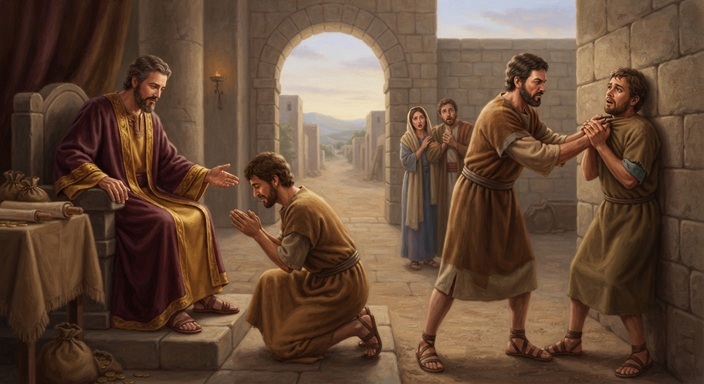
2. The Parable of the Unforgiving Servant
Jesus tells the story of a servant who owes his master an enormous debt.
The servant cannot repay it.
He falls before his master and begs:
“Have patience with me, and I will pay you back in full.”
The master has compassion on him.
He does something extraordinary.
He forgives the entire debt.
The servant receives mercy that he could never have earned by himself.
But then something shocking happens.
That same servant finds another servant who owes him a much smaller amount.
Instead of showing the same mercy he has received, he demands payment.
He even has the man thrown into prison.
The master is angry because the servant has received mercy but refused to show mercy to another.
3. We Have Received Great Mercy from God
The first reading gives us an important lesson:
“Forgive your neighbour’s injustice; then when you pray, your own sins will be forgiven.”
Sirach reminds us that we ourselves are people who need forgiveness.
None of us can stand before God and say:
“I have never done anything wrong.”
We have all needed God's mercy.
We have received forgiveness from God many times.
We have fallen.
We have asked for mercy.
And God has continued to receive us.
Therefore, the forgiveness we receive from God should change the way we treat others.
Those who know they have received mercy should become merciful people.
4. “Could You Not Have Had Pity?”
The master says to the unforgiving servant:
“Should you not have had mercy on your fellow servant, as I had mercy on you?”
This is the central question of today's Gospel.
God has shown us mercy.
Can we then refuse to show mercy to others?
God forgives our sins.
Can we continually hold the sins of others against them?
God gives us another opportunity.
Can we refuse to give another person an opportunity to change?
The Gospel challenges us to examine our hearts.
5. Forgiveness Is Not Easy
Jesus knows that forgiveness is difficult.
Some wounds are deep.
Some betrayals are painful.
Some words cannot simply be forgotten.
Some experiences leave lasting scars.
Therefore, Jesus is not saying that forgiveness means pretending that nothing happened.
Forgiveness does not mean saying that wrongdoing is acceptable.
It does not mean that we should place ourselves in situations where someone can continue to harm us.
Rather, forgiveness means refusing to allow hatred and resentment to control our hearts.
We can recognize that something was wrong while still choosing not to live in hatred.
6. “The Life and Death of Each of Us Has Its Influence on Others”
The second reading says:
“None of us lives for oneself, and no one dies for oneself.”
St Paul reminds us that our lives are connected.
What we do affects other people.
Our anger affects others.
Our forgiveness affects others.
Our bitterness affects others.
Our kindness affects others.
When we refuse to forgive, the wound can continue to influence our lives and our relationships.
But when we forgive, we begin to break the cycle of resentment.
Our forgiveness can become a source of healing.
7. Forgiveness Begins in the Heart
Jesus ends the parable with a very strong statement:
“So will my heavenly Father do to you, unless you forgive your brother from your heart.”
Notice the words:
“From your heart.”
Jesus is not talking merely about saying:
“I forgive you.”
while continuing to carry hatred inside.
Christian forgiveness must gradually reach the heart.
We may need time to heal.
We may need prayer.
We may need God's grace.
But we must make the decision to release the desire for revenge and place the situation in God's hands.
8. “Remember the End of Your Life”
The first reading gives us another powerful reminder:
“Remember the end of your life, and set enmity aside.”
This is a very practical piece of wisdom.
Life is short.
One day, our earthly journey will come to an end.
Why should we spend our limited time carrying hatred?
Why should we allow resentment to consume our hearts?
Why should we refuse to speak to someone for years because of an old disagreement?
The reading invites us to remember our own mortality and therefore to let go of unnecessary hatred.
9. Forgiveness and Our Relationship with God
Today's readings make forgiveness a serious spiritual matter.
We cannot separate our relationship with God from our relationship with other people.
If we ask God for mercy, we must also learn to show mercy.
If we ask God to forgive us, we must be willing to forgive.
If we want to live in God's peace, we cannot deliberately keep hatred alive in our hearts.
This is why Jesus makes forgiveness such an important part of Christian discipleship.
Conclusion
Dear brothers and sisters,
Today's readings give us a simple but challenging message:
We have received mercy; therefore, we must show mercy.
Peter asks Jesus:
“How often must I forgive?”
Jesus answers:
“Not seven times but seventy-seven times.”
The message is not that we should keep a record of forgiveness.
The message is that forgiveness should have no fixed limit in the Christian heart.
Let us therefore ask ourselves:
- Is there someone I have refused to forgive?
- Am I carrying an old resentment in my heart?
- Have I received God's mercy but refused to show mercy to others?
- Am I allowing anger and bitterness to control my relationships?
- Is there someone I need to forgive from my heart?
May God give us the grace to forgive.
May He heal the wounds we carry.
May He free us from hatred, resentment and the desire for revenge.
And may we never forget the mercy that God Himself has shown us.
Let us take seriously the words of the master to the unforgiving servant:
“Should you not have had mercy on your fellow servant, as I had mercy on you?”
May the mercy we receive from God become the mercy we show to others.
Amen.