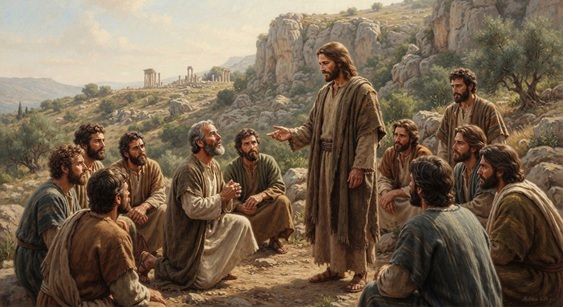
You Are the Christ, the Son of the Living God.
Dear brothers and sisters in Christ,
Today's Gospel contains one of the most important conversations between Jesus and His disciples. Jesus asks them a simple but profound question:
“Who do people say that the Son of Man is?”
The disciples give different answers. Then Jesus makes the question personal:
“But who do you say that I am?”
This is not merely a question for Peter and the apostles. It is a question for every Christian.
1. “Who Do People Say That I Am?”
Jesus first asks what other people are saying about Him.
The disciples respond:
“Some say John the Baptist, others Elijah, and still others Jeremiah or one of the prophets.”
The people had different opinions about Jesus. They recognized that He was special, but they had not yet fully understood who He truly was.
Today, there are also many opinions about Jesus.
Some see Him as:
- a great teacher,
- a prophet,
- a moral leader,
- a miracle worker,
- or simply an important historical figure.
But Christianity asks us to go beyond what other people say.
2. “But Who Do You Say That I Am?”
Jesus now turns the question directly toward His disciples:
“But who do you say that I am?”
Peter answers:
“You are the Christ, the Son of the living God.”
This is the heart of our Christian faith.
Jesus is not simply a teacher among many teachers.
He is the Christ, the Messiah, the Son of the living God.
Peter's answer is therefore not just information. It is an act of faith.
And Jesus tells Peter that this knowledge did not come from human reasoning alone:
“Blessed are you, Simon son of Jonah. For flesh and blood has not revealed this to you, but my heavenly Father.”
Faith is ultimately a gift from God.
3. Jesus Gives Peter a Mission
After Peter's profession of faith, Jesus gives him a new identity and responsibility:
“You are Peter, and upon this rock I will build my Church.”
Jesus gives Simon the name Peter, meaning rock.
Peter will become a foundation stone in the visible structure of Christ's Church.
Jesus continues:
“I will give you the keys of the Kingdom of heaven.”
The image of the keys is important. In the first reading, Isaiah speaks about the authority given to Eliakim over the house of David. Jesus uses similar imagery when entrusting Peter with authority in His Church.
This is one of the biblical foundations for the Petrine ministry and the role of the Pope as successor of Peter.
4. The Church Belongs to Christ
Jesus says:
“I will build my Church.”
Notice the words:
“My Church.”
The Church does not belong to the Pope.
It does not belong to the bishop.
It does not belong to the priest.
It does not belong to any particular group of Catholics.
The Church belongs to Jesus Christ.
The Pope, bishops, priests, religious, and lay faithful are all servants of Christ and stewards of His Church.
Therefore, when we experience difficulties within the Church, we should not lose faith in Christ.
Human beings can fail, but Christ remains faithful.
5. “The Gates of the Netherworld Shall Not Prevail”
Jesus makes a powerful promise:
“The gates of the netherworld shall not prevail against it.”
The Church has faced many difficulties throughout history:
- persecution,
- division,
- scandals,
- false teachings,
- wars,
- opposition,
- internal weaknesses.
Yet after two thousand years, the Church continues to proclaim the Gospel.
Why?
Because the Church does not survive merely through human strength.
Christ is with His Church.
6. What Does Jesus Mean to Me?
The most important question today is not:
“Who do other people say Jesus is?”
It is:
“Who do I say Jesus is?”
Is Jesus simply someone we hear about on Sunday?
Or is He truly:
- our Lord,
- our Saviour,
- our Redeemer,
- the centre of our lives?
Our answer should affect how we live.
If Jesus is truly Lord, then His teachings should influence:
- our decisions,
- our relationships,
- our use of money,
- our attitude toward others,
- our forgiveness,
- our moral choices.
Faith must become a way of life.
7. Peter Was Not Perfect
There is another important lesson.
Peter makes this magnificent profession of faith, but we know that Peter was not perfect. Later, he would deny Jesus three times.
Yet Jesus still chose him.
This reminds us that God does not call only perfect people.
He calls ordinary, imperfect people and gives them grace to serve Him.
Perhaps we sometimes think:
“I am too weak to serve God.”
But Peter's life tells us otherwise.
God can work through our weaknesses when we surrender ourselves to Him.
Conclusion
Dear brothers and sisters,
Today's Gospel leaves us with a question that we cannot avoid:
“But who do you say that I am?”
Let us not answer only with our lips.
Let our lives answer the question.
May we be able to say with Peter:
“You are the Christ, the Son of the living God.”
And may our faith in Christ lead us to remain faithful members of His Church, trusting that no power of evil can ultimately overcome the Church that He Himself has built.
Amen.