Preparing the Soil of Our Hearts.
Dear brothers and sisters in Christ,
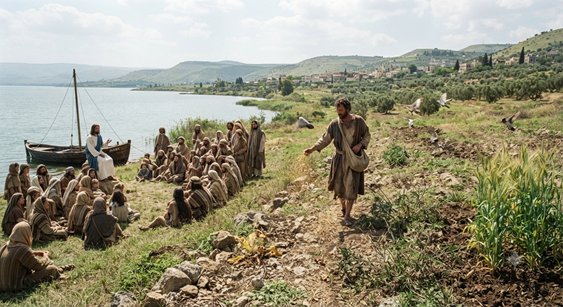
Today's Gospel presents one of the most well-known parables of Jesus—the Parable of the Sower. It is a simple story about a farmer scattering seed, but it carries a profound message about our relationship with God.
In this parable, the seed is the Word of God, the sower is God Himself, and the different types of soil represent the condition of our hearts.
The important question is not whether God is speaking. He is always speaking. The real question is:
What kind of soil is my heart?
1. The Seed That Fell on the Path
Jesus says that some seed fell on the path, and the birds came and ate it.
This represents people who hear God's Word but never truly receive it. Their hearts have become hard, like a footpath trampled by many feet.
Today, our hearts can become hardened by:
- pride,
- resentment,
- constant distractions,
- or indifference to God.
When we refuse to listen, God's Word cannot take root.
The first step toward spiritual growth is to have an open and humble heart.
2. The Seed on Rocky Ground
Some seed fell on rocky ground. It sprang up quickly but soon withered because it had no deep roots.
These are people who receive God's Word with joy but give up when difficulties arise.
Many people are enthusiastic about their faith when life is easy, but when they face:
- illness,
- disappointment,
- criticism,
- or suffering,
their faith weakens.
A mature faith needs deep roots.
These roots grow through:
- daily prayer,
- reading Scripture,
- participation in the Eucharist,
- and perseverance during difficult times.
3. The Seed Among Thorns
Other seed fell among thorns, and the thorns choked it.
Jesus explains that the thorns are the worries of the world and the lure of riches.
This is perhaps one of the greatest challenges today.
Our lives are often crowded with:
- work,
- social media,
- entertainment,
- financial concerns,
- the desire for success.
These things are not wrong in themselves, but if they occupy all our attention, they leave little room for God.
The question is not whether we have thorns, but whether we are willing to remove them.
4. The Seed on Good Soil
Finally, some seed fell on rich soil and produced a harvest—thirty, sixty, and even a hundredfold.
The good soil represents those who:
- hear God's Word,
- understand it,
- accept it,
- and live it.
Notice that the fruitfulness varies, but every good soil produces something.
God does not expect us all to produce the same results, but He expects each of us to bear fruit according to the gifts He has given us.
The fruits of a Christian life include:
- love,
- kindness,
- patience,
- forgiveness,
- generosity,
- peace,
- and faithful service.
5. God Never Stops Sowing
One beautiful lesson from this parable is that the sower scatters seed generously.
He does not give up because some seed is lost.
Likewise, God never stops speaking to us.
He continues to sow His Word:
- in every Mass,
- through Sacred Scripture,
- through the teachings of the Church,
- through the example of holy people,
- and even through the ordinary events of our lives.
God is patient. He never stops inviting us to grow.
Conclusion
Dear brothers and sisters,
Today's Gospel invites each of us to examine the soil of our hearts.
- Is my heart hardened like the path?
- Is my faith shallow like the rocky ground?
- Are worldly worries choking God's Word in my life?
- Or am I striving to become good soil that bears abundant fruit?
As we receive God's Word today, let us ask Him to remove whatever prevents His grace from taking root in our lives.
May our hearts become rich soil, so that the seed of His Word may grow, bear fruit, and bring glory to God.
"Whoever has ears ought to hear."
Amen.