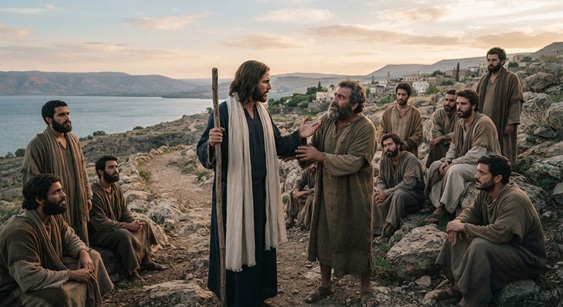
Take Up Your Cross and Follow Me.
Dear brothers and sisters in Christ,
Last Sunday, we heard Peter make a beautiful profession of faith:
“You are the Christ, the Son of the living God.”
Jesus praised Peter and entrusted him with a special responsibility in the Church.
But today's Gospel gives us a surprising continuation of that story. The same Peter who had just professed Jesus as the Messiah now tries to prevent Jesus from speaking about His suffering and death.
Jesus says:
“Get behind me, Satan! You are an obstacle to me.”
What happened to Peter?
Peter understood that Jesus was the Messiah, but he did not yet understand what kind of Messiah Jesus was.
1. Peter Wanted a Messiah Without the Cross
Jesus tells His disciples that He must go to Jerusalem, suffer, be killed, and be raised on the third day.
Peter cannot accept this.
He takes Jesus aside and says:
“God forbid, Lord! No such thing shall ever happen to you.”
Peter loved Jesus, but he wanted Jesus to follow Peter's idea of what the Messiah should be.
Peter expected victory without suffering.
But Jesus came to save humanity through the Cross.
This can happen to us too.
Sometimes we want:
- Christianity without sacrifice,
- blessings without obedience,
- resurrection without Good Friday,
- success without struggle.
But Jesus teaches us that the Christian journey includes the Cross.
2. “You Are Thinking Not as God Does”
Jesus tells Peter:
“You are thinking not as God does, but as human beings do.”
This is a powerful warning.
Human thinking often tells us:
“Avoid suffering at all costs.”
But God sometimes allows suffering to become part of our journey toward something greater.
This does not mean that we should seek suffering or enjoy pain.
Rather, when difficulties come because of our commitment to what is good and true, we should not abandon Christ.
3. “Whoever Wishes to Come After Me…”
Jesus then gives one of the clearest descriptions of discipleship:
“Whoever wishes to come after me must deny himself, take up his cross, and follow me.”
There are three things here.
Deny Yourself
Self-denial does not mean hating ourselves.
It means refusing to make ourselves the centre of everything.
It means learning to say:
“Not what I want, Lord, but what You want.”
We deny ourselves when we choose forgiveness instead of revenge, honesty instead of dishonesty, and generosity instead of selfishness.
Take Up Your Cross
Everyone has crosses in life.
Some are:
- family difficulties,
- financial struggles,
- sickness,
- disappointment,
- rejection,
- responsibilities,
- sacrifices made for those we love.
The Christian does not carry the cross alone.
Jesus carries it with us.
The Cross becomes a path to holiness when we unite our suffering and sacrifices with Christ.
Follow Me
Jesus does not simply say, "Carry your cross."
He says:
“Follow me.”
This is important.
Christianity is not about suffering for the sake of suffering.
We carry our crosses while following Christ.
Jesus walks ahead of us.
4. “Whoever Loses His Life for My Sake Will Find It”
Jesus gives us a paradox:
“Whoever wishes to save his life will lose it, but whoever loses his life for my sake will find it.”
The world often tells us:
“Put yourself first.”
Jesus tells us:
“Give yourself in love.”
Think about parents.
A mother or father sacrifices sleep, comfort, money, and personal desires for their children.
Why?
Because love makes sacrifice meaningful.
The same is true of our relationship with God.
When we give ourselves to Christ, we do not lose our lives. We discover their true purpose.
5. What Profit Is There in Gaining the Whole World?
Jesus asks:
“What profit would there be for one to gain the whole world and forfeit his life?”
This is a question for our modern world.
We can spend our entire lives pursuing:
- money,
- possessions,
- career,
- popularity,
- influence.
But none of these can save our souls.
At the end of life, we cannot take our possessions with us.
What matters is whether we have lived in love and remained faithful to God.
6. Jeremiah and the Cost of Following God
The first reading gives us the example of the prophet Jeremiah.
Jeremiah complains that proclaiming God's Word has brought him suffering and rejection.
Yet he cannot simply walk away.
He says that God's Word becomes like a fire burning within him.
This reminds us that genuine faith sometimes requires courage.
When following God becomes difficult, we should not immediately conclude that God has abandoned us.
Sometimes difficulty is precisely the moment when our faith must become stronger.
Conclusion
Dear brothers and sisters,
Today's Gospel gives us a difficult but beautiful message:
There is no resurrection without the Cross.
Jesus does not promise us a life without difficulties.
He promises to walk with us through them.
Let us therefore ask ourselves:
- Am I willing to follow Christ even when it is difficult?
- What cross is God asking me to carry faithfully?
- What do I need to deny in myself so that Christ can reign more fully in my life?
- Have I become too attached to worldly success?
May we never be ashamed of the Cross.
May we follow Jesus faithfully, trusting that the Cross is not the end.
Beyond the Cross is Resurrection.
And beyond our earthly journey is eternal life with God.
“Whoever wishes to come after me must deny himself, take up his cross, and follow me.”
Amen.